There's a type of talking about AI I am allergic to. I have been trying to put my finger on exactly what it is that fires up this allergy. I finally found a word to put to it reading "Reverse Centaur's Guide to Life After AI" where Corey Doctorow refers to the cause of my allergy as 'Inevitablism;' the belief that the long-term social and economic consequences of the bucket of technologies we call "AI" are not only predictable, but inevitable.
We once had a client look at us and say 'we need to be planning for when there are no more websites.' Since they were paying us to build them websites, my allergies kicked in. I could feel my eyes starting to itch. I'm all for science fiction hypothesizing about where we're heading. I love that kind of thinking! It wasn't the speculation that made my allergies kick in. It was that it was presented as inevitable.
I even do inevitablism to myself. Being allergic to yourself is not fun! I used Claude to write code and build some tools recently. I am not a coder. But I bought the inevitable story. Claude can write great code so anyone can build anything they want. It's easy now!
I outsourced most of the thinking to the robot. And then the tokenmaxxing started. Claude would write code, something wouldn't work the way I thought it should, I would tell it what went wrong and it would confidently tell me it understood the problem. Then it would fix that problem and create another one. I kept pushing forward because somewhere in my head I had accepted the premise that the hard part had basically been solved. AI writes the code now. I just needed to keep asking the right questions and giving the right prompts. It'll get good eventually. It didn't get good.
AI has made it possible for me to build things I could not have built before. That is genuinely cool. It has not made the act of building inevitable, automatic, or even particularly easy. There are still decisions everywhere. There are still tradeoffs. You still have to understand what you are trying to make. You still have to decide whether the thing the robot just built is actually any good. This is probably obvious to most readers.
But I think what may be less obvious is the way that inevitablism creeps in. It is not that I disagree with all the predictions. I actually like a lot of them. I think AI probably will change huge parts of how we work (achoo!). I think employers probably will care less about degrees over time (sniffle!). I think people will move through education and work in much less linear ways. I think short-term training and credentials are going to become more important. I think software is going to become much easier for more people to make (cough!). I got those all out with just mild hives.
What I reject is the jump from "this seems like where things are heading" to "therefore we already know what this world looks like." If people need to reskill more often, who helps them decide which programs are worth their time? If AI makes software cheaper to build, what gets built? Who gets to build it? What values get embedded in it? If training programs become more important, how do people decide which ones they trust?
None of those questions have inevitable answers! The shape is wide open to be influenced by forces both good and evil. And posing them as questions instead of inevitabilities makes my allergies feel less acute...but I'm still a little sniffly.
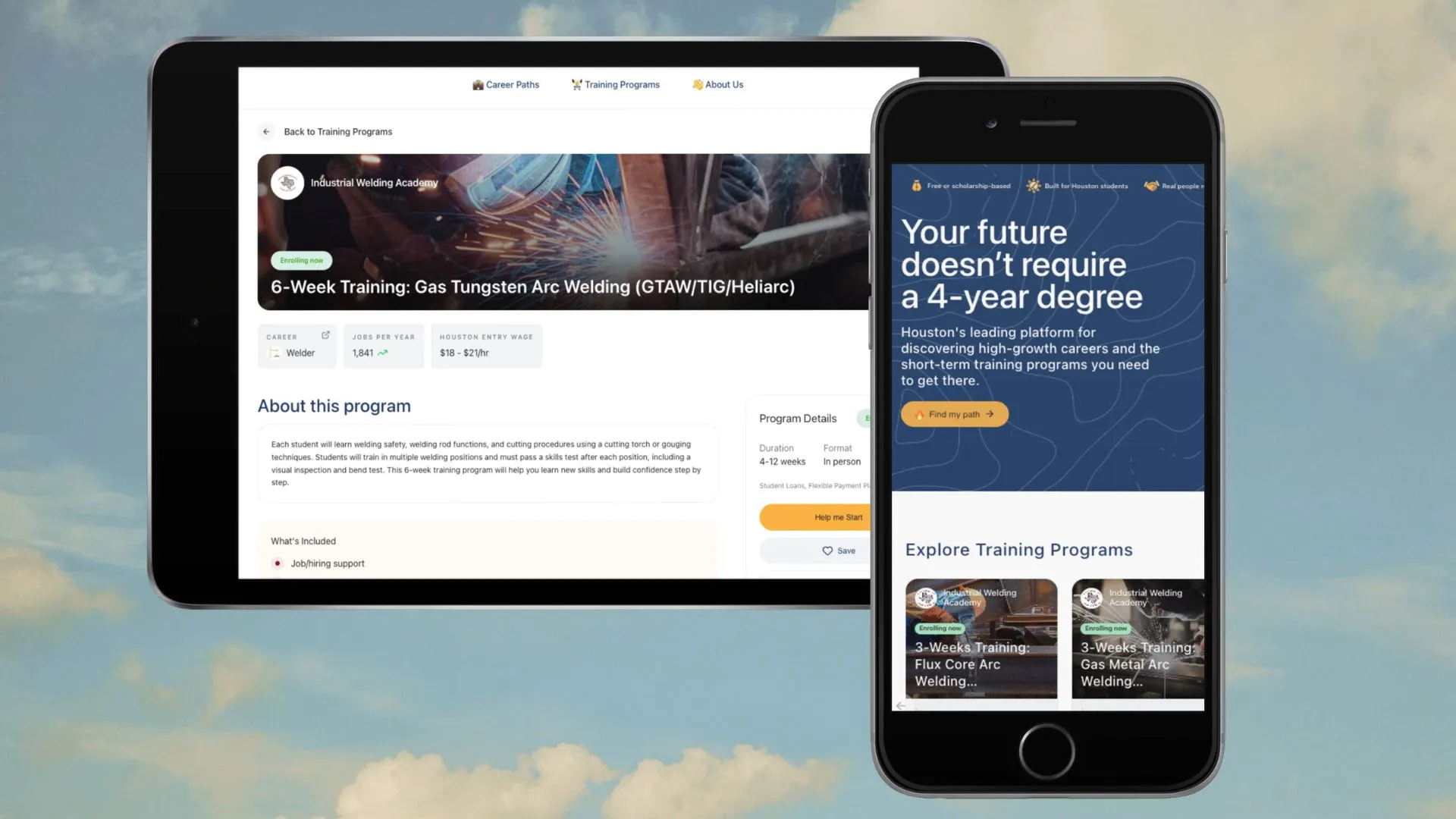
At WhereWeGo we spend a lot of time thinking about a future where people have more pathways into good careers than the traditional routes. One where every available training program is easy to find and understand. I hope that future happens. I am actively trying to make some version of it happen. But there is no law of technology or economics that says the version we end up with will be good. We could end up with thousands of new credentials that nobody understands. We could make it easier than ever to enroll in training programs that aren't a good fit for you. We could build AI career advisors that push people toward whatever providers paid to be recommended. We could replace one opaque system with another opaque system and call it innovation.
Lots of work to be done! We have so many great partners we're thinking about these problems with. Let me go take some Claritin and get back to work.