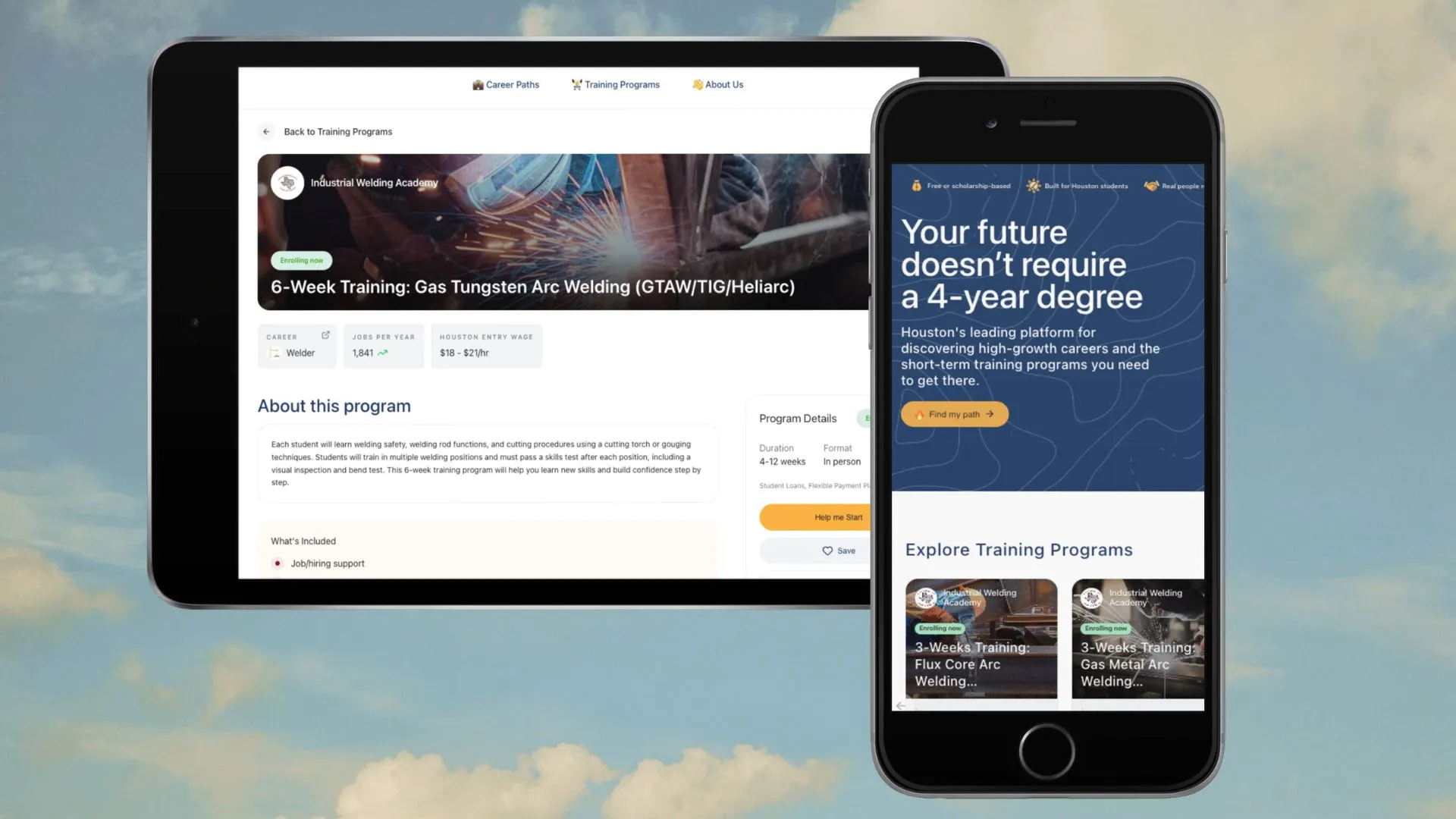
Every state has an Eligible Training Provider List. The ETPL exists because federal law requires it. If a training program wants to be eligible for WIOA-funded tuition, it has to be on the list. The list usually lives on a state workforce agency website, in a table, sorted by provider name, with columns like "CIP Code" and "Performance Indicator."
That format makes sense for compliance officers. After observing countless user experiences, the list is not a practical utility for the worker or student user.
I've wanted to fix this for years. The ETPL is one of the most underutilized assets in workforce development — a state-validated list of training programs, already vetted, already tied to outcomes data, already updated. The raw material is there. It's just packaged for the wrong audience. Though it is missing countless other options, for a WIOA-eligible individual, it by definition has them all.
A few weeks ago, I (not a coder) built a worker-facing ETPL for Mississippi's list. Though I have a large appetite and many methods for how to make a training navigator have better value, it was important to cap the appetite at 7 (business) days for the sake of the use case. It was my first ever line of code. Seven days*, start to finish. Here's what happened and what it means.
*Seven days has a big asterisk
The Mississippi Career Training Navigator has over 10,000 lines of code. It went through hundreds of iterations and dozens of data moves forward and backward. The reason it took seven days and not seven months is that our back-end tech infrastructure was already built: my devs handed me a childproof toybox of sorts and I just got to put all the legos together exactly how I wanted. We have one-shot data pipeline solutions for workforce data. We've been refining career training data architecture for eight years. What used to take a development team six months to wire up, like taxonomies, data validation, occupation-to-program crosswalks, career pathway visualization, is now a system I can extend in days. In other words, "seven days" is possible for us because our team has templatized these sorts of things, and that solid and proven technical infrastructure did not take seven days.
The other reason it was fast: my role at WhereWeGo has expanded. I still curate the strategy and specs around product and market fit, but now I'm also much closer to the code itself. My developers help define what the product needs to be performant, secure, and production-ready, and I work directly in AI tools to move from strategy into implementation faster.
So when Mississippi's data was ready, I could go from setting up a data ingest to a worker-facing interface for the first time, without waiting on the usual list of critical environment setup work. I used our internal template base with all its baked-in skills, VS Code, Claude Code, a smattering of datasets, and my noggin.
The speed unlock = excellent infra + subject matter expertise on the problem + AI-assisted development.
What changes when you rebuild an ETPL for workers
The Mississippi ETPL, in its native form, is essentially a spreadsheet. It tells you a program exists. It does not help you decide whether to enroll.
Here's what we did differently:
Connected programs to careers. Most ETPLs list programs in isolation. We connected each program to the occupations it leads to, with wage data, growth data, and future-ready for pathway visualization.
Progressive disclosure. Any teacher can tell you too much information at one time will prevent a learner from learning. The same is true for making decisions about career pathways. The MS ETPL used some of the most basic and essential strategies for reducing cognitive overwhelm.
Beauty & elegance. Okay, a loaded term. But, you know how Coco Chanel apparently famously said: "Before you leave the house, look in the mirror and take one thing off." This is another thing that is true for making decisions about career pathways.
In other words, just as many of the iterations were spent deleting the features as adding them. This ETPL feels nice, approachable…actionable.
Future-proofing with a medallion architecture
A quick aside on how I built the data layer, because I know where awesome training navigators end up and this ETPL refresh is phase 1, of many. So, it has to be compatible with the future. To do this, I used a "medallion" architecture. I learned this on day 2, after I found where my data pipelines were going to break/become ungovernable messes:
- Bronze: raw data. Every row from the Harvard Workforce Almanac. Every program from CareerOneStop's API for that region. Advanced CTE's taxonomy. Things like that.
- Silver: connected data. Programs joined to industries joined to occupations joined to wages. The crosswalks between datasets that start to create meaning.
- Gold: validated data. Information confirmed by the program itself, or human-verified review data, or peer social proof. The architecture to one day have the info that leads to sustainable trustworthiness.
Without an architecture that distinguishes raw data from connected data from validated data, we would end up shipping bad information at scale.
Public datasets on career training are messier than most people realize. We've found public training datasets in some regions where up to half the entries are false positives. And there are just as many real programs missing from the list. After vetting the real programming in real regions, I'd blanketly assume an ETPL represents less than half of what's out there.
Why this
The starting place is that every state's ETPL can still be a compliance tool for some but also a decision-making tool for others. It could help a real person make one of the riskiest decisions of their life with the same quality of information they'd get researching local sandwiches.
We estimate at least 50,000 training programs in the United States at any given time. Almost no worker knows what they are. The data kinnnnnd of exists. The infrastructure kinnnnnd of exists. Broad, all-careers-included, region-wide, worker-facing access surely does not.
The workforce development boards, school districts, economic development organizations, departments of labor and education, and large workforce nonprofits express great frustration at how far we still have to go when it comes to closing that last mile between person and career training. Closing the last mile has many yards to fill, but easily knowing at least which programs provide federal aid near you is a start.
If that sounds like what you want to work on, the seven-day build is real! The Mississippi navigator is totally portable. It's a configuration of a system designed to be extended state by state, region by region, sector by sector. And there are countless new opportunities it deserves to include.
Lemme at it!
Want to see the Mississippi navigator or talk about what this could look like for your state or region? Get in touch.
Written by Leah Lykins