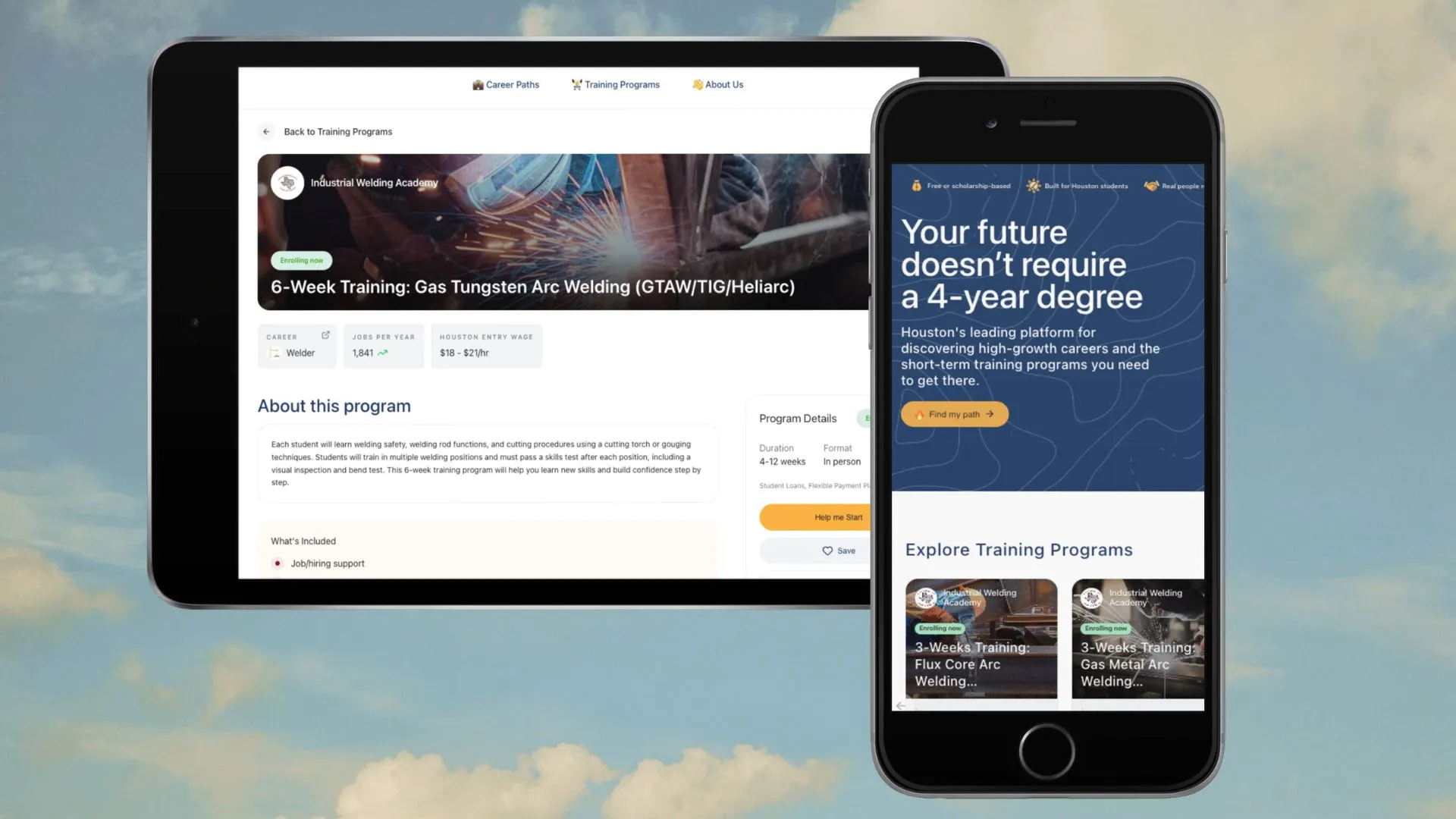
If you run short-term training at a community college, workforce board, or sector partnership in Florida, Louisiana, New York, or California, the next six weeks decide whether your students can use a Pell Grant to pay for your programs. We built a free tool that tells you in 90 seconds whether a program will qualify under the new federal rules: workforce-pell.labs.wherewego.org.
This post covers what Workforce Pell is, what qualifies, why your state matters as much as the federal rules, and how we built the tool.
What is Workforce Pell?
Workforce Pell lets students use a Pell Grant to pay for short-term workforce training. It was authorized in Section 83002 of the One Big Beautiful Bill Act (signed July 2025) and goes live July 1, 2026.
Until now, Pell paid for degree programs. Workforce Pell is the first crack in that policy. It targets the short, credential-focused programs community colleges and training providers already run: practical nursing, CDL, welding, medical assisting, IT certifications, HVAC.
What programs qualify for Workforce Pell?
A program has to land in a specific window:
- 150 to 599 hours of instruction
- 8 to 14 weeks long
- 70% completion rate
- 70% of completers placed in jobs
- Median earnings 3 years out above 150% of the federal poverty line ($23,475 in 2026)
- Awards a credential employers actually recognize
- Has run for at least one year
- Offered by a school that already takes federal student aid
The Department of Education's proposed rule went through public comment, which closed April 8, 2026. The final rule is expected before launch.
Why state approval matters as much as the federal rules
Federal rules are the same everywhere. State approval is not.
Each state names an agency to approve programs, and every program has to match a job that's actually in demand in that state. A CDL program might qualify in Florida and not qualify somewhere else where commercial driving isn't on the in-demand list.
Florida is the furthest along of the four states we cover. The Master Credentials List, run by CareerSource Florida and the Department of Commerce, is a ready-made backbone for Workforce Pell approval.
Louisiana, New York, and California are still working out which agency will own the process. Our tool gives each state its own briefing page so workforce leaders know who to watch and who to call.
How the tool answers the question in 90 seconds
A Workforce Pell answer sits on top of four data sources: federal eligibility rules, state employment projections, state-level wage data, and (where one exists) an officially approved credentials list. Each is published by a different agency, in a different format, on a different cadence. Stitching them together is most of the work.
We pulled federal job projections and state-level wages for around 100 occupations across the four states. For Florida, we ingested the Master Credentials List and cross-referenced every job in our tool against the 427 occupations Florida has formally approved. That's the difference between a good guess and a verified answer.
Plain language is the whole product
Workforce policy is full of acronyms the rules use but the people on the ground don't. We dropped Title IV, ETPL, UI wage data, and OBBBA in favor of phrases users actually say: "school offers federal aid," "approved training providers," "the state checks earnings using its own records."
Every section header is a question, because workforce people skim and search engines reward the same questions real users type.
Three of the four states haven't published their official Workforce Pell list yet. The tool says so plainly on those pages instead of inventing data to fill the gap. Honest gaps make a thing that gets forwarded. Confident overreach makes a thing nobody shares.
Built small, built durable
The tool is built on the WhereWeGo Labs philosophy of small, durable tooling. No AI at runtime. No hallucination risk. No ongoing API costs.
The federal rule lives in one file. When the Department of Education finalizes its rule, someone updates that file, the tests prove the change is clean, and the site reflects it. State data lives in separate files, each editable by hand. Every scorecard prints clean as a one-page PDF, because workforce deans print things and walk them into board meetings, and a board-meeting handout that looks like a webapp screenshot loses every time.
We shipped it in 30 days. That's the Labs bar: someone asked for it, it could help workers, and we could ship a lightweight version in a month.
Need this for your state, system, or program portfolio?
Try the tool first: workforce-pell.labs.wherewego.org. Run a program through it. Print the scorecard.
Then, if any of these sound familiar, write us:
- You're in a state we don't cover and you need this fast
- Your state has a credentials list and someone has to ingest it
- You have a portfolio of programs and you need a bulk eligibility check
- You're sitting on workforce data spread across half a dozen state agencies
- You need a UX layer on top of a WIOA system
- You need a navigator for any program where the answer changes by state
Email me at leah@wherewego.org.